A room regulator is a device that affects home comfort and heating costs. It decides when the boiler should heat and when to turn off. If it is installed in the wrong location, the system may operate less economically.
Introduction
In this article we explain where to place the room controller, at what height to mount the room controller, and how to choose a place that is truly "representative" of the whole house.
Why does the installation location of the room controller matter so much?
Many people focus on the choice of boiler, radiators or underfloor heating, and treat the location of the controller as a detail. Meanwhile, it is the location of the room controller that very often determines whether the house is stably warm and whether the heating system works sensibly.
The room controller does not "know" what the temperature is in the whole house. He only sees what is happening exactly at the point where it is mounted. Based on this one piece of information, it controls the operation of the entire heating system. If it hits a spot that is:
- cooler than the rest of the house,
- warmer than the rest of the house,
- exposed to the sun, drafts or heat sources,
then it will start making the wrong decisions. The result? Overheating some rooms, underheating others, frequent switching on and off of the boiler, and higher energy consumption.
Therefore, instead of treating the installation of a controller "somewhere on the wall," stop for a moment and choose the location consciously.
Where to place the room controller in the house?
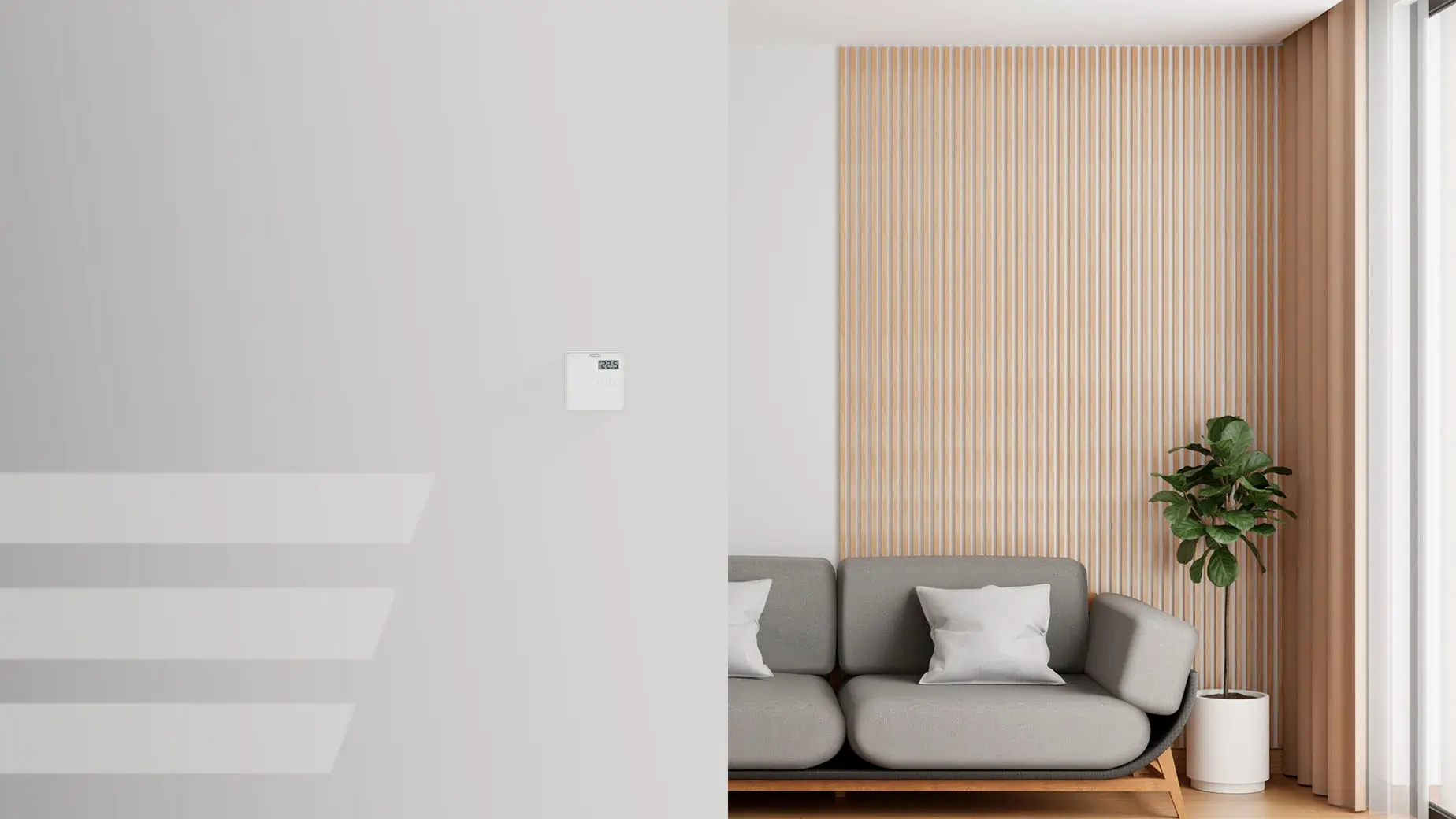
The best choice is a room that can be considered representative of the temperature for the entire house. In practice, this is most often the living room or the living room, the place where:
- a lot of time is spent;
- the temperature should be the most comfortable;
- there are no extremes (like the vestibule or kitchen when cooking).
The idea is that the controller "looks" at a temperature that actually reflects what you consider to be thermal comfort in your home. If you mount it in a random place, the entire heating system will react to conditions that have little to do with the daily use of the building.
To make your choice easier, go through each item on the checklist.
CHECKLIST: Where is the best place to install a room controller?
Answer the following questions for yourself and you will quickly find the right place
- Is it in a room that represents the temperature of the entire house well (such as the living room)?
- iI it away from direct sunlight during the day?
- Is it away from the fireplace, heater and other heat sources?
- Is it located away from exterior doors and draft zones?
- Can air circulate freely in this location?
- Will the controller be in this location unobstructed by furniture, curtains or other elements?
If you answer most or all of these questions in the affirmative, there's a good chance that the controller will show a temperature at this location that is really close to the one you experience at home.
At what height to mount the room controller?
The second key question is at what height to mount the room controller. The standard assumption is that the optimal height is about 140-150 cm from the floor.
This is not a random value. This is more or less the height at which:
- the "life" zone of the householder is located;
- the air is neither noticeably cooler (as near the floor) nor warmer (as under the ceiling);
- the measurement is closest to the real perceived temperature.
Mounting the controller much lower or much higher almost always results in a skewed reading, and this in turn leads to unnecessary adjustments in heating operation.
What to absolutely avoid when installing?
Even a well-chosen room and a good height will not help if the controller hits an unlucky spot on the wall. It is very common to find mounted controllers:
- above the radiator;
- by the balcony door;
- on a wall that is strongly heated by the sun;
- close to a TV, fireplace or lamps;
- in a corner with poor air circulation.
In each of these cases, the controller gets "falsified" information about the temperature and begins to control the heating in a way that has little to do with the real needs of the house.
What about wireless controllers?
A wireless controller gives you a big advantage: you can rearrange it and see in practice where the measurement is most reliable. Not sure which room best represents the overall temperature in your home? This is the solution for you.
However, it's important to remember that the rules for choosing the location are exactly the same as for wired controllers. A wireless controller should not stand just anywhere either.
How do you know if the controller is hanging in the wrong place?
Sometimes the installation is technically sound, the boiler works properly, and yet the comfort in the house is strange and unstable. Very often the reason turns out to be precisely the location of the regulator.
CHECKLIST: Symptoms of a misplaced room controller
Answer the following questions for yourself:
- Is the temperature in the house unstable, even though the settings on the controller do not change?
- Does the boiler turn on and off suspiciously often for no apparent reason?
- Is it clearly too warm in some rooms and too cold in others?
- Does the controller show a temperature that does not agree with your real feeling?
- Is the energy consumption for heating clearly higher than you expected?
If you answer yes to several of these questions, it is very possible that the problem is precisely the poorly chosen location of the room controller, not the heating settings themselves.
Where you place the room controller and at what height you mount it has a real impact on comfort and heating costs. A well-chosen place makes the whole system work quietly, stably and economically. And poorly selected - can spoil the operation of even the best installation.
FAQ: Where to place the room controller? We give you a hint!
1. Where to place the room controller in the house?
It is best to install it in a representative room, such as the living room or living room. This should be a place where the temperature reflects well the conditions throughout the house.
2. At what height to mount the room controller?
As a standard, it is recommended to mount at a height of about 140-150 cm from the floor. At this height, the temperature measurement is closest to what the householders realistically feel.
3. Can the room controller hang in the hallway?
It can, but only if the corridor has a stable temperature and is not exposed to drafts or frequent opening of external doors. Otherwise, the measurement will be falsified.
4. Can the controller be installed in the bedroom?
Yes, but only if the bedroom well represents the temperature of the whole house. If the bedroom tends to be cooler than the rest of the building, it may disturb the heating system.
5. can the room controller hang close to the radiator?
No, because the heat from the radiator will falsify the temperature reading. As a result, the boiler may shut down too early or operate unstably.
6. Does the sun affect the operation of the room controller?
Yes, direct sunlight can strongly overestimate the temperature reading. This causes the heating to turn off even though the house is realistically still cool.
7. Can the wireless controller be placed anywhere?
No, although it can be easily repositioned, exactly the same rules for site selection apply as for a wired controller. He, too, must stand in a representative place and free from interference.
8. Does the location of the controller really affect heating bills?
Yes, a poorly placed controller can cause the house to overheat or underheat. This directly translates into higher energy consumption.
9. How do you know if the controller is mounted in the wrong place?
Most often this manifests itself in unstable temperatures in the house and frequent switching on and off of the boiler. Often, too, the controller's indications do not agree with what the householders actually feel.
10. Can changing the location of the controller improve the performance of the heating?
Very often yes, and without changing any settings in the controller. A well-chosen location can clearly improve comfort and reduce energy consumption.