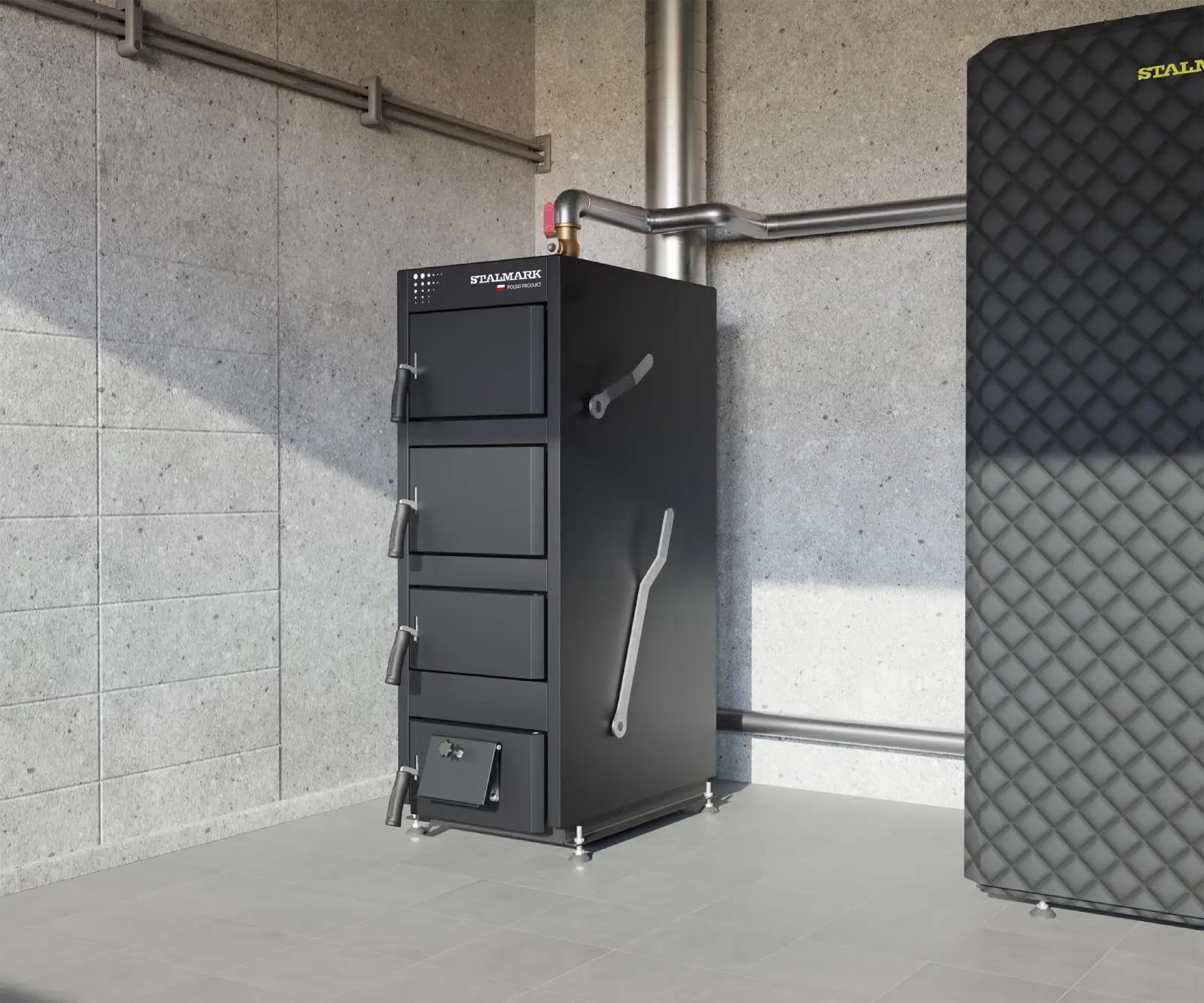
BACA is a new manual coal boiler from Stalmark that combines simple operation and robust construction with Class 5 and EcoDesign requirements. Without an electronic controller or fan, available in power outputs of 14, 18, 22, and 28 kW.
Key Information
- BACA is a new coal boiler from Stalmark, designed around simple operation. The boiler itself requires no electronics, fan, or electricity supply.
- The model is available in power outputs of 14, 18, 22, and 28 kW, features a heat exchanger made of 6 mm steel sheet, and a 36 cm deep fuel chamber.
- The boiler meets Class 5 and EcoDesign requirements.
BACA. A boiler built around simplicity
In recent years, the development of heating technology has been strongly associated with automation. Controllers, feeders, fans, internet modules, and extensive automation can increase convenience, but not every user prioritizes these features. BACA joins the Stalmark range as an answer to a different need: a design that is as simple as possible and a reduction in the number of components requiring power supply or electronic control!
This is a deliberately different direction than in the case of many central heating boilers equipped with advanced automation. In BACA, operation is meant to remain direct and straightforward. Lighting is done traditionally using wood, and the primary fuel for the appliance is coal.
The slogan "Reliability starts with simplicity" describes the product's core concept well, but in practice, concrete design solutions are what matter most. It is these solutions that demonstrate what BACA brings to the offer.
No electronics or fan. What does this mean in practice?
The BACA coal boiler does not require an electronic controller or a fan to operate. It also does not require the unit itself to be connected to electricity. For the user, this primarily means a simpler operation method and a design free from some of the components typical of more automated boilers.
It is worth clearly distinguishing two issues here. The lack of power supply to the boiler does not automatically mean that every central heating system with BACA will be completely independent of electricity. Circulation pumps, motorized valves, or other system components may require power depending on how the system is designed. Therefore, the final boiler room layout should be tailored to the specific building and system.
For comparison, the Stalmark offer also includes pea coal boilers with a feeder, where automatic fuel feeding and control represent a completely different user philosophy. BACA does not try to copy it. Its role is to provide an alternative for people who prefer a more traditional solution.
BACA's construction: 6 mm heat exchanger sheet steel and a 36 cm fuel chamber
Simple design does not mean sacrificing solid technical specifications. BACA's heat exchanger is made of 6 mm thick steel sheet. This is one of the model's fundamental design parameters and a key feature to consider when comparing devices intended for long-term boiler room operation.
The second practical feature is the 36 cm deep fuel chamber. This dimension is designed to make adding fuel and daily boiler maintenance easier. In a manual boiler model, the ergonomics of this component are particularly important, as the user is personally responsible for adding fuel.
Therefore, BACA is not a feature-heavy appliance. Here, the true value lies in a straightforward design: a fuel chamber, a robust heat exchanger, and keeping electronic components to a minimum—or rather, their complete absence in the boiler itself.
Four power variants: 14, 18, 22, and 28 kW
BACA will be available in four power variants: 14, 18, 22, and 28 kW. This range allows matching the device to buildings with different heat demands, but the area of the house alone is not enough to correctly select the boiler output.
Energy demand is influenced by, among other things, building envelope insulation, airtightness, type of ventilation, heated area, design temperature for the location, and domestic hot water preparation method. Therefore, two houses with the same floor area should not automatically be equipped with a boiler of the same power.
Oversizing the boiler can impair its operating conditions, while insufficient output may not provide the expected amount of heat on the coldest days. Selecting a specific BACA variant should therefore be based on the building's demand, not just the number of square meters.
Class 5 and Ecodesign in a classic design
The most interesting feature of BACA is the combination of a classic boiler concept with declared compliance with modern emission requirements. The Baca model meets Class 5 and Ecodesign requirements.
Class 5 refers to the requirements for solid fuel boilers specified in the PN-EN 303-5 standard, while the Ecodesign requirements for solid fuel boilers stem from Commission Regulation (EU) 2015/1189. These are two related but distinct reference points for heating equipment parameters, including efficiency and pollutant emissions.
Who was the BACA coal boiler created for?
BACA is not a product for everyone, and that might just be its strong suit. A user expecting automatic fuel feeding, an advanced controller, and remote control should look for a different type of device. BACA meets the needs of people who consciously choose a simpler way of heating.
- for users who prefer traditional, manual boiler operation;
- for people who do not need an electronic controller and a fan in the boiler itself;
- for investors looking for a coal boiler in several power variants, with a traditional method of adding fuel;
- for users who value a design that is as simple as possible and easy access to the loading chamber;
- for people who want to select a device based on the specific demand of the building rather than relying solely on floor area before purchasing.
BACA expands the Stalmark product range with a model that is distinctly different from designs focused on maximum automation. As a result, the user can choose not only between fuel types and power, but also between different philosophies of boiler room operation.
Simplicity does not mean a random choice of installation system
This is the most important practical note when presenting BACA. The simpler the design of the boiler itself, the more crucial the proper design of the entire heating system becomes. The selection of power output, pipe diameters, system protection methods, chimney, water circulation, and control elements should comply with the device's technical documentation and the conditions of the specific building.
Therefore, the absence of electronics should not be taken as a sign that the device can be selected 'by rule of thumb'. BACA simplifies boiler operation, but it remains a heat source that must work with a properly constructed central heating system.
In case of doubt, it is worth consulting the selection of power output and configuration with a Stalmark representative and the installer responsible for executing the boiler room.
Check local regulations before buying a coal boiler
Requirements for operating solid fuel boilers are not uniform across Poland. Anti-smog resolutions apply in most voivodeships, and some cities and municipalities have introduced additional restrictions regarding the installation or operation of coal-fired appliances. Therefore, before choosing BACA, you must check the rules applicable specifically to the planned installation site.
Meeting the technical requirements of the device and the ability to legally operate it in a given location are two different issues. Therefore, the purchasing decision should be preceded by verifying the current anti-smog resolution for the voivodeship and, if applicable, the local resolution in force in the municipality or city.
BACA joins the Stalmark offering
BACA shows that expanding an offering doesn't always have to mean adding more features. In this model, simplicity was the starting point: no electronics, no fan, no power supply required for the boiler itself, and a traditional operation method, along with specific structural parameters and four power variants.
At Stalmark, we develop our offer of central heating boilers in various directions, from automated feeder devices to wood gasification boilers. BACA brings to our portfolio the most classic solution in terms of operation, but designed as a new product rather than a return to devices from years ago.
BACA. Reliability begins with simplicity.
FAQ
Does the BACA boiler require electricity?
The BACA boiler itself does not require an electrical power supply, electronic controller, or fan. However, this does not automatically mean that the entire central heating system will operate without power, as its other components may require electricity.
What power outputs does the BACA boiler offer?
BACA is available in four variants: 14, 18, 22, and 28 kW. Power selection should be based on the heat demand of the building, not solely on its floor area.
Does BACA have an electronic controller and a fan?
No. According to the launch materials, BACA does not require an electronic controller or fan. Fuel is added through the loading chamber, which has a depth of 36 cm.
How is the BACA boiler ignited?
Ignition is carried out traditionally using wood. Coal is the primary fuel for BACA.
Does BACA meet Class 5 and EcoDesign requirements?
Such compliance is declared in Stalmark's product materials prepared for the model's launch. Class 5 and EcoDesign refer to requirements regarding solid fuel boiler parameters, but local regulations regarding the installation and use of coal boilers should also be checked prior to purchase.
Summary
BACA is an option for users who do not expect maximum automation from a boiler. Its key feature is precisely the reduced complexity: no electronics, fan, or power supply required for the boiler itself, traditional operation, a heat exchanger made of 6 mm steel sheet, and a 36 cm deep loading chamber. Four power variants allow matching the model to various building requirements.
At the same time, BACA is designed to be a product that meets modern requirements in its category. The boiler complies with Class 5 and EcoDesign standards. This makes the release not a story about an "old boiler in a new casing," but about consciously engineered simplicity.
To select the appropriate power variant and check model availability, you can contact a Stalmark sales representative. After purchase, users also have access to Stalmark service.